Published by:
CGP EDU Academic Team
Published on: September 12, 2026
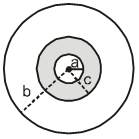
A spherical capacitor is made of two conducting spherical shells of radii a and b = 3a. The space between the shells is filled with a dielectric of dielectric constant K = 3 upto a radius c = 2a as shown. If the capacitance of given arrangement is n times the capacitance of an isolated spherical conducting shell of radius a. Then find value of n.
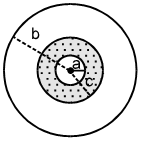
Text Solution
Verified by ExpertsThe correct answer is:
4
Step 1: Calculate the capacitance of the spherical capacitor in two regions.
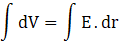
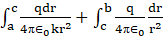
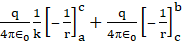
The potential difference for the outer shell (b) and the inner shell (a) is derived as follows:
1. For the inner region (from radius a to c), the capacitance is given as:
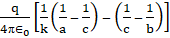
$$C_1 = \frac{Q}{V_1} = \frac{Q}{\frac{Q}{4\pi\epsilon_0 K a}( \frac{1}{a} - \frac{1}{c})}$$
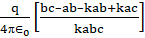
= \frac{4\pi\epsilon_0 K ac}{(c-a)}
where K = 3 and c = 2a, substituting these values gives C1 = \frac{12 \pi \epsilon_0 a}{a} = 12\pi\epsilon_0.
2. For the outer region (from c to b), the capacitance is given as:
$$C_2 = \frac{Q}{V_2} = \frac{Q}{\frac{Q}{4\pi\epsilon_0 b}( \frac{1}{c} - \frac{1}{b})}$$
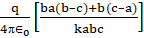
= \frac{4\pi\epsilon_0 b(c-a)}{K}.
Substituting the values provides: C2 = \frac{12\pi\epsilon_0 b}{b - 2a} = 12\pi\epsilon_0.
Step 2: Combine the two capacitances in series to find the total capacitance:
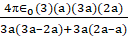
$$\frac{1}{C} = \frac{1}{C_1} + \frac{1}{C_2} = \frac{1}{12\pi\epsilon_0} + \frac{1}{12\pi\epsilon_0} = \frac{1}{6\pi\epsilon_0}$$
Finally, the capacitance of an isolated spherical conducting shell of radius a is given by: $$C_0 = 4\pi\epsilon_0 a$$.
Therefore, the ratio n of capacitances is:
$$n = \frac{C}{C_0} = \frac{6\pi\epsilon_0}{4\pi\epsilon_0 a} = 4$$.
Hence, value of n is 4.
The potential difference for the outer shell (b) and the inner shell (a) is derived as follows:
1. For the inner region (from radius a to c), the capacitance is given as:
$$C_1 = \frac{Q}{V_1} = \frac{Q}{\frac{Q}{4\pi\epsilon_0 K a}( \frac{1}{a} - \frac{1}{c})}$$
= \frac{4\pi\epsilon_0 K ac}{(c-a)}
where K = 3 and c = 2a, substituting these values gives C1 = \frac{12 \pi \epsilon_0 a}{a} = 12\pi\epsilon_0.
2. For the outer region (from c to b), the capacitance is given as:
$$C_2 = \frac{Q}{V_2} = \frac{Q}{\frac{Q}{4\pi\epsilon_0 b}( \frac{1}{c} - \frac{1}{b})}$$
= \frac{4\pi\epsilon_0 b(c-a)}{K}.
Substituting the values provides: C2 = \frac{12\pi\epsilon_0 b}{b - 2a} = 12\pi\epsilon_0.
Step 2: Combine the two capacitances in series to find the total capacitance:
$$\frac{1}{C} = \frac{1}{C_1} + \frac{1}{C_2} = \frac{1}{12\pi\epsilon_0} + \frac{1}{12\pi\epsilon_0} = \frac{1}{6\pi\epsilon_0}$$
Finally, the capacitance of an isolated spherical conducting shell of radius a is given by: $$C_0 = 4\pi\epsilon_0 a$$.
Therefore, the ratio n of capacitances is:
$$n = \frac{C}{C_0} = \frac{6\pi\epsilon_0}{4\pi\epsilon_0 a} = 4$$.
Hence, value of n is 4.
Prepare Smarter with CGP Edu
Get practice questions, solutions, and test series in one place.
Write a Review
Share your experience with this question and solution.
Commentary
Send your comment, doubt, correction, or feedback to admin.
Similar Questions
Explore conceptually related problems
The capacity of a parallel plate condenser is . When a glass plate is placed between the plates of…
A capacitor is charged by using a battery which is then disconnected. A dielectric slab is then sli…
The energy of a charged capacitor is given by the expression ( $\alpha$ = charge on the conductor a…
The capacity of a condenser is $4 \times 10^{-6}$ farad and its potential is 100 volts . The energy…
The insulated spheres of radii $R_1$ and $R_2$ having charges $Q_1$ and $Q_2$ respectively are conn…
In a charged capacitor, the energy resides